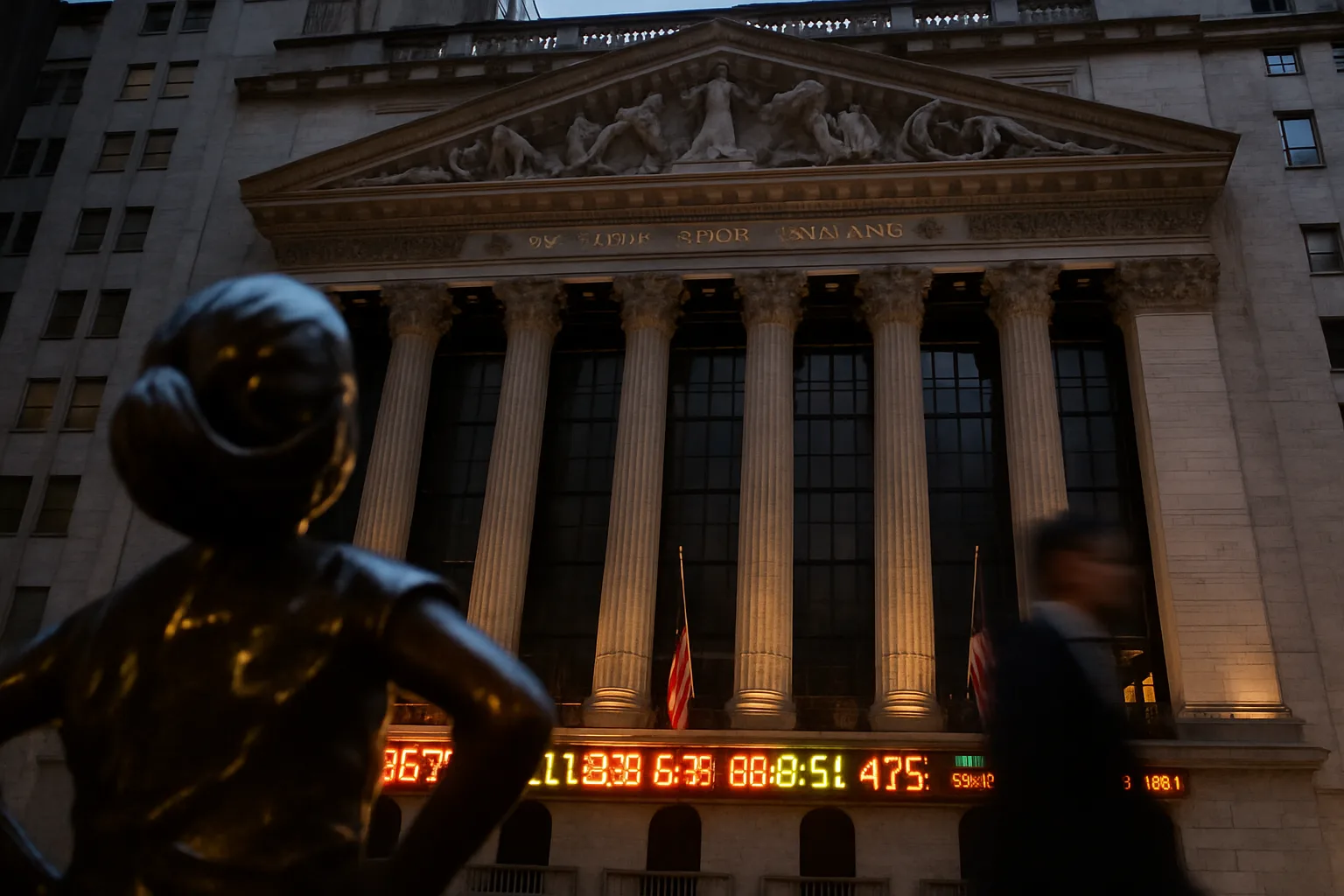
US equity futures were trading higher in early premarket action on October 21, with contracts tied to the Nasdaq‑100 leading gains as investors monitored commodity prices and awaited domestic market catalysts.
Futures on the Nasdaq‑100 rose sharply relative to other contracts, while S&P 500 and Dow Jones futures posted more modest gains. The technology‑heavy Nasdaq outperformance pointed to continued investor preference for growth and megacap names in overnight electronic trading.
Futures point higher, led by Nasdaq
Nasdaq‑100 futures advanced notably ahead of the New York open, adding several hundred points in the premarket snapshot. S&P 500 futures were up modestly, while Dow futures showed smaller gains. The gap in performance underlines the market’s skew toward large‑cap technology exposure this session.
Traders said the overnight activity reflected a combination of continued interest in AI and software beneficiaries, profit‑taking patterns in cyclicals, and flows repositioning ahead of a busy economic calendar this week. With US markets poised to react to inflation data, central bank commentary and corporate earnings updates, early positioning in futures often sets the tone for regular hours.
European equities drift lower despite pockets of strength
European bourses were generally weaker in late‑morning trade. The FTSE 100, CAC 40 and several continental indices were slightly down, while Switzerland’s SMI and Spain’s IBEX bucked the trend with modest gains.
Market participants cited mixed economic indicators across the region and profit taking after recent rallies as factors weighing on sentiment. Currency movements and energy prices also played a role, with exporters and commodity‑linked sectors more sensitive to swings in the euro and oil.
Asia mixed as Nikkei rallies, Hang Seng lags
Asian markets were mixed overnight. Japan’s Nikkei 225 climbed, supported by gains in technology and industrial names, while Hong Kong’s Hang Seng index lagged, reflecting local market pressures and China‑related macro sensitivity.
Regional divergence highlighted the continued dispersion of investor appetite across markets: investors rotated into markets perceived as offering clearer earnings momentum while remaining cautious on those exposed to regulatory or property‑sector risks.
Commodities: oil firm, precious metals soften
Energy futures led commodity moves in the premarket snapshot. Both WTI and Brent crude futures were higher, lifting energy‑linked sentiment across markets. The oil advance reflected a combination of supply concerns and ongoing demand resilience in parts of Asia and the US.
Precious metals were softer: gold and silver futures eased in early trade, pressured by the firmer dollar at times and the rise in real yields. Metals traders noted that any sustained climb in US rates would be a headwind for bullion.
"Oil’s move is keeping broader sentiment tilted toward cyclicals in some pockets, but it’s not yet broad enough to flip the overnight strength in technology futures," said a derivatives strategist.
Currencies steady, dollar around recent levels
Major currency pairs were little changed in the snapshot. The euro traded marginally lower versus the dollar, while sterling held near the previous close. The yen showed slight firming against the greenback after earlier weakness.
Currency traders flagged the near‑term absence of major central‑bank decisions as a factor reducing volatility, though focus remains on upcoming economic releases that could reset interest‑rate expectations.
How traders approach the open
With futures signalling a positive start to the US session, market participants said volatility around key data points — including inflation and jobs metrics that remain on the calendar — could still produce intraday rotations between growth and value sectors.
Institutional desks typically use premarket futures to hedge or adjust exposures prior to the cash open, while retail activity in premarket hours can amplify moves in heavily traded names. The premarket snapshot is intended to provide an early read of sentiment but, importantly, these indicative prices are provided by market makers and may differ from exchange‑reported levels.
Analysts caution investors to treat premarket moves as directional rather than definitive, given lower liquidity and the potential for sharper price swings ahead of full market participation.
"Premarket is a temperature check — useful for gauging direction and risk appetite, but the real test comes with volume in regular trading hours," said a market microstructure analyst.
Outlook for the trading day
The session ahead will likely hinge on incoming US economic releases, corporate earnings headlines and any developments in energy markets. If oil maintains its gains, sectors such as energy and certain industrial names could outperform, even as technology retains momentum from secular demand drivers.
Investors will also be watching currency moves and fixed‑income yields for signals about interest‑rate trajectories, which remain central to valuations across asset classes.
Market participants advised balancing short‑term reaction trades with awareness of the broader macro context, as headline‑driven moves can reverse quickly when liquidity returns.
Premarket indicators provide an early sense of market direction but are not substitutes for the depth and pricing transparency of regular trading hours.
The premarket data snapshot is an early read on global risk appetite. Traders and investors will look to the cash session to confirm whether the overnight bias toward technology and higher oil prices persists into broader market leadership.
Sources & further reading