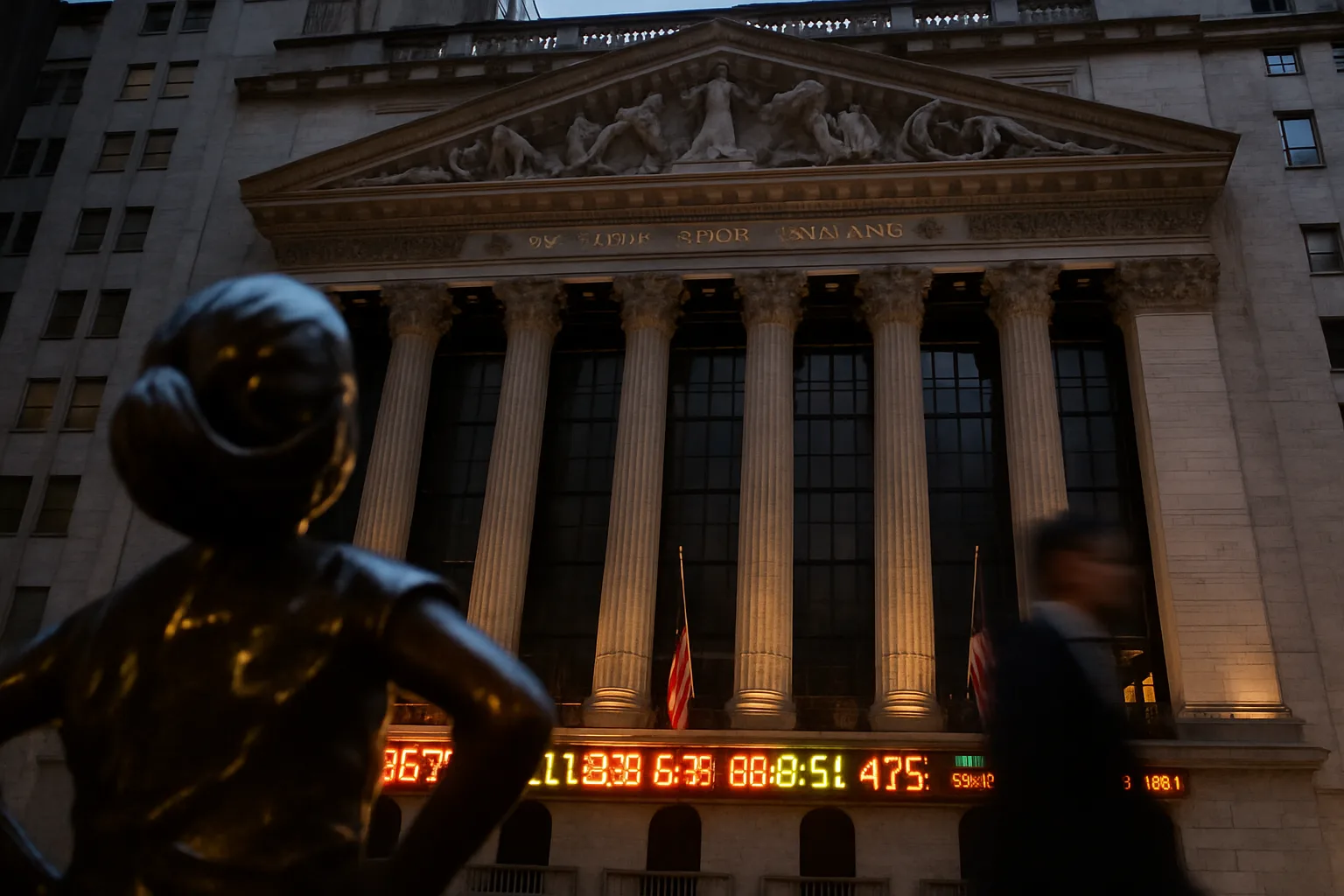
US equity markets closed Tuesday in a mixed session as investors rotated away from the market's biggest technology names and reset positions ahead of a busy corporate earnings slate.
The Dow Jones Industrial Average outperformed, rising about 1%, while the S&P 500 gained roughly one-third of a percent. The Nasdaq Composite lagged, slipping into negative territory as many of the largest technology and internet stocks traded lower. Traders said the divergence reflected profit-taking in mega-cap growth names even as broader market breadth improved.
Earnings set the agenda
Corporate results dominated trading as investors awaited earnings from high-profile companies. SpaceX and Netflix reported after the bell, while Tesla and Meta remained on the calendar for later in the week. Market participants said the immediate reaction to results and management guidance was likely to steer market direction in the near term.
Netflix's third-quarter report illustrated the risk: the company posted revenue in line with estimates but issued a fourth-quarter top-line outlook below Wall Street consensus, prompting a notable sell-off in its shares. SpaceX, by contrast, was reported to have posted a quarterly beat and saw its stock tick higher in extended trading.
Analysts and traders said the patchwork of results is testing the market's ability to climb without synchronized leadership from the largest cap technology firms. The S&P 500, for instance, remains below its record close and will need both broad participation and continued earnings strength to regain highs.
AI trade frays and credit concerns
Attention to the AI trade intensified after the troubled debut of Elice, a South Korean data-centre provider, whose shares plunged more than 30% on their first day of trading. The sharp drop revived investor caution about valuation and funding risks for companies reliant on heavy capital expenditure to service AI workloads.
The launch of a dedicated AI infrastructure bond ETF further highlighted the intersection of equity enthusiasm and credit-market stress. The new vehicle directs investors into bonds tied to companies in the AI ecosystem, a move that comes even as the cost of insuring some of those companies' debt has been rising. Credit-market strains for certain AI suppliers and specialist borrowers have raised questions about the durability of the sector's rally.
"AIBN makes it deliberate," the chief investment officer of the ETF issuer said, referring to an effort to give investors explicit exposure to AI-related fixed income.
Market strategists said the combination of concentrated equity positions in AI leaders and widening credit spreads on smaller, leveraged participants creates vulnerability to sudden repricing episodes.
Sector rotation and breadth
While mega-cap tech names tended to weigh on the Nasdaq, the day's rally showed breadth within the broader market. Small-cap and cyclical sectors outperformed, and health care names pushed the Health Care Select Sector to fresh highs on strength in major drugmakers and insurers.
Chipmakers and AI-infrastructure suppliers were mixed: early weakness in semiconductor shares gave way to intra-day buying for some names, but the sector's uneven performance — and high short-term volatility — left traders cautious. Oil prices eased from elevated levels, helping airlines and homebuilders to participate in the advance.
Investors also monitored developments among defence contractors, where several companies raised profit outlooks amid continued geopolitical uncertainty, providing a counterpoint to the technology-driven narrative.
Macro backdrop and fixed income
Fixed-income metrics remained a backdrop for equity valuation discussions. The benchmark 10-year Treasury yield hovered at levels that keep downward pressure on price-to-earnings multiples for long-duration growth stocks. Separately, housing starts were reported to have slipped to a multi-month low, underscoring persistent softness in parts of the domestic economy amid elevated mortgage rates.
Traders said the path of Treasury yields, and whether treasury-market moves accelerate or ease, will be a key determinant of whether investors press risk assets higher or clamp down on exposure to interest-rate sensitive sectors.
What to watch next
Market attention will remain on quarterly corporate results coming through the week, with Tesla and Meta among the next high-profile reports. Investors will also be watching credit-market signals — including default-swap levels and bond spreads for AI-related issuers — for signs that funding strains could spill over into equities.
A successful re-acceleration in tech leadership would make it easier for the broad market to regain its record levels; absent that, analysts expect choppier trading and perhaps further divergence between the megacaps and the rest of the market.
Stocks may react to any fresh economic data or changes in Treasury yields, but in the short run earnings and sector-specific credit stories are likely to be the dominant drivers of market moves.
Sources & further reading